 how-to
How to Plan Wedding Car Hire for Multiple Venues
Last Updated: November 11, 2026
Quick Summary
Wedding car hire for multiple venues works best when you build a written route plan listing every collection, stop and drop-off with realistic travel time between each, then add a buffer to every leg. Confirm passenger numbers, separate collection addresses, waiting time and extra charges with your supplier in writing before you book.
- Count passengers and check the bride's dress size before choosing vehicles, not after.
- A typical three-location day sends the groom's car 30 minutes early and the bridal car 5 to 10 minutes before the start.
- Allow the photographer's full photo stop time plus ten minutes to get everyone back in the car.
- Booking the ceremony car only and assuming it stays for the reception is the most common multi-venue mistake.
- Give a printed timetable to the chauffeur, photographer, venue coordinator and best man.
Table of Contents
- Why Wedding Car Hire for Multiple Venues Needs a Plan
- Choosing Cars for Wedding Transport Between Venues
- Wedding Car Route Planning Across Several Stops
- Coordinating Arrival Times on the Day
- Wedding Transport for Guests Between Venues
- Wedding Car Hire by the Hour: How Charges Add Up
- Questions to Ask a Supplier About Multi-Venue Bookings
- Enquire About Multi-Venue Wedding Car Hire
- Frequently Asked Questions
Why Wedding Car Hire for Multiple Venues Needs a Plan
Wedding car hire for multiple venues means moving the bridal party, the couple and sometimes guests between two or more locations on the same day, each with its own arrival deadline.
Timings are worked out down to the minute when a couple is juggling several venues. That habit matters more than the car itself.
The tricky part is that guests move themselves, but the bride, groom and bridal party cannot. They must arrive calm, on time and photographed.
Below, we break down how to plan the route, the fleet, the timings and the charges. For a closer look at the two-venue scenario, our guide on planning wedding transport between two venues walks through timings, photographs and passengers step by step.
Choosing Cars for Wedding Transport Between Venues
The right vehicles for multi-venue transport balance passenger capacity, access and how they photograph at each location. A grand luxury car suits an estate reception; a cream classic campervan suits a rustic barn.
Matching the Fleet to Your Route and Party Size
Start with people, not cars. Count the bride, the groom, the bridesmaids, the parents travelling with the bridal party and anyone who needs to be at the ceremony early. Then check the dress. A full gown with a train needs room to sit without crushing, and a classic car's rear seat is often shorter than a modern limousine's.
Buyers should consider the room they need in the car, including how big the bride's dress is and how many people it must carry.
If you are unsure how many vehicles to book, our guide on how many wedding cars you need sets out a simple way to count passengers and plan the fleet.
Multiple-Car Packages and Separate Collection Addresses
Multi-venue days often need more than one car, and separate collection addresses are a detail couples should confirm in writing.
| Requirement | Single Car | Two-Car Package |
|---|---|---|
| Bride and groom at different addresses | Tight | Comfortable |
| Bridesmaids travelling separately | Squeeze | Easy |
| Photographs of both arrivals | One angle | Two angles |
| Flexibility if one route delays | Limited | Strong |
Wedding Car Route Planning Across Several Stops
Route planning is where multi-venue transport succeeds or fails. A wedding car route plan lists every collection, stop and drop-off in order, with realistic travel time between each. Build it before you book, not after.
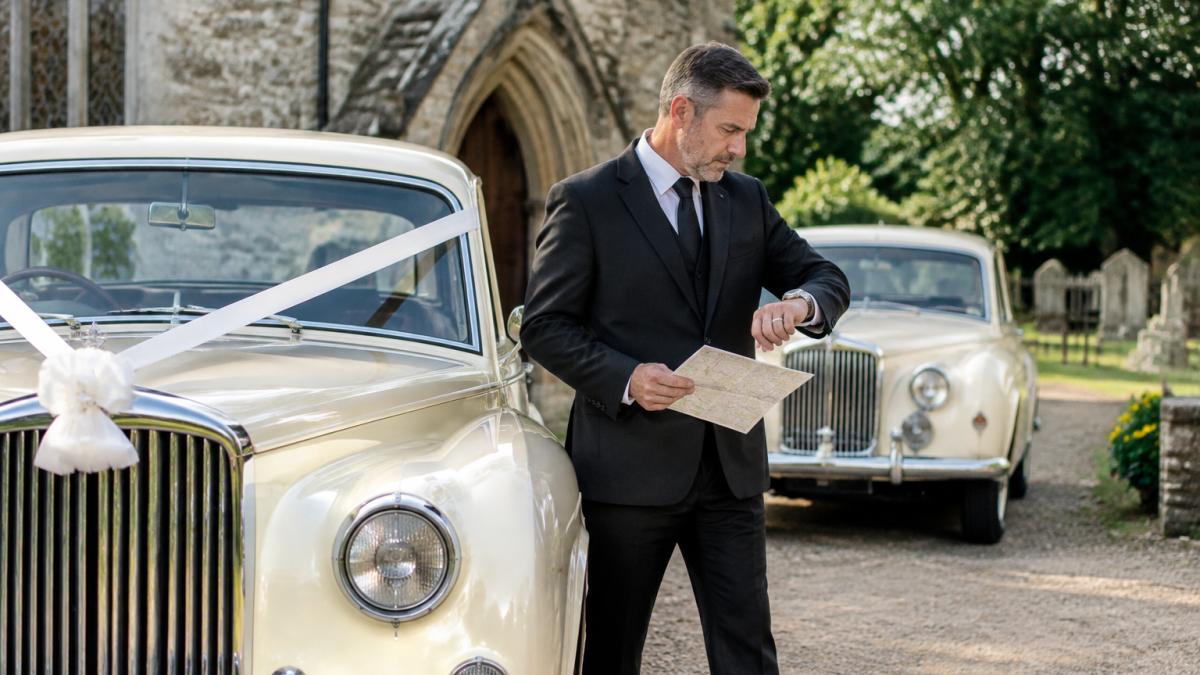
Start with the map, not the timetable. Plot the ceremony venue, the reception venue and any photo stop, then drive the route yourself or check it carefully on a mapping tool.
Sequencing Collections, Ceremony, Reception and Photo Stops
A workable multi-venue sequence usually runs in one of two patterns. The split start: the groom and groomsmen leave from one address and arrive early, while the bride leaves from another and arrives closer to the start. The convoy start: the bridal party gathers at one house, travels together to the ceremony, then the same cars move everyone to the reception and any photo stop.
Whichever pattern you choose, fix the order of stops before you fix the times. A typical sequence for a three-location day looks like this:
- Groom's car collects the groom and groomsmen from Address A and arrives at the ceremony venue 30 minutes before the start.
- Bridal car collects the bride and her party from Address B and arrives at the ceremony venue 5 to 10 minutes before the start.
- After the ceremony, the bridal car takes the couple to a photo stop for 20 to 30 minutes while guests make their own way to the reception.
- The bridal car then delivers the couple to the reception, arriving ahead of the guests where possible.
- If a second car is booked, it moves the bridesmaids or parents from the ceremony to the reception after the couple has left.
Write that sequence down and give a copy to every chauffeur, the photographer and the venue coordinator. A route plan that lives only in the bride's head fails at the first delay.
Building in Travel Time and Waiting Time
Waiting time is the hidden cost of a multi-venue day. Chauffeurs wait while photographs are taken, while guests find their seats and while the couple signs the register. Build a buffer into every leg.
Add a cushion to each journey and treat it as fixed, not optional. If the ceremony overruns, the cushion absorbs it; if not, you arrive early, which is far better than arriving after the bride.
Alternative routes can be planned in advance, from leaving the first venue to returning after the booking ends.
Watch out: booking the car for the ceremony only and assuming it will stay for the reception is the most common multi-venue mistake.
Coordinating Arrival Times on the Day
Coordinating arrival times means working backwards from the ceremony start and forwards from the reception, so every vehicle has a clear deadline.
Give each vehicle its own schedule. The car carrying the groom and groomsmen usually arrives first. The bridal car follows, timed so the bride steps out close to the start. Any car moving guests to the reception leaves after the ceremony photos begin.
Share that schedule with everyone who needs it: the chauffeur, the photographer, the venue coordinator and the best man. A single printed timetable, held by the right people, prevents most of the day's confusion.
Wedding Transport for Guests Between Venues
Wedding transport for guests between venues is a separate problem from the bridal car. Guests drive themselves, share lifts or rely on a coach or minibus, and they need to know when and where to move. Leave them to guess and a handful will arrive at the reception an hour late.
Put the details on the invitation or a separate information card: the ceremony address, the reception address, the distance between them and the time guests should leave. If you are laying on a coach, give a clear departure time and a named meeting point.
For couples with many out-of-area guests, a simple shuttle between venues removes the parking worry and keeps the day moving.
Wedding Car Hire by the Hour: How Charges Add Up
Fuel, mileage and waiting terms should be stated plainly before you book.
Extra Mileage, Waiting and Additional Stops
Quotes for wedding car hire can include extra charges when a multi-venue day runs beyond the booked hours or distance. Common extra charges to check are:
- Extra mileage. A route that crosses two or three venues can add miles quickly, especially if a photo stop sits off the direct line. Ask what the included mileage is and the rate per additional mile.
- Waiting time. Time spent stationary while photographs are taken is still time the car and chauffeur are committed. Some suppliers include a waiting allowance; others charge by the half-hour or hour.
- Additional stops. A diversion to a viewpoint, a family home or a second collection address may be treated as an extra stop with its own charge, or it may simply extend the hours. Agree it before the day.
Split Journeys and Extended Hire
Ask your supplier how a split journey, where the car drops one group, returns later or covers separate collection addresses, is priced compared with a continuous hire.
If the reception might run past the booked finish, ask your supplier how an extension is priced and agree it upfront.
We do not publish fixed figures here because every route differs. Our wedding car hire prices page sets out our packages and guide prices, and a tailored quote confirms exactly what is included for your day, the hours, the mileage allowance, the waiting terms and any charge for additional stops or separate collection addresses.
Questions to Ask a Supplier About Multi-Venue Bookings
Ask these questions before you commit, and get the answers in writing:
- How many vehicles will we need for our passenger count and dress size?
- Are separate collection addresses included, and is there an extra charge?
- How is waiting time between venues charged?
- What is the contingency plan if a car breaks down or a route is blocked?
- How do you build in travel time between venues, and who confirms the schedule?
- What exactly is included in the price: fuel, mileage, chauffeur hours?
- Can we see examples of multi-venue weddings you have handled locally?
A supplier who answers these clearly, without hesitation, is one you can trust with a complicated day. Our own wedding car hire FAQs cover services, pricing and the booking process if you want to see how we answer them.
Enquire About Multi-Venue Wedding Car Hire
A multi-venue wedding day rewards planning. Confirm the passenger count, the dress, the collection addresses and the schedule early, and the transport becomes the calmest part of the day.
If your ceremony, reception and photographs sit in three different places, tell us about the day and we will help you work out the fleet and the timings. Check availability and request a tailored quote from our family-run team.
Multi-venue transport only works when the plan is built before the day, not improvised on it. West Sussex Classic Wedding Cars offers chauffeur-driven vintage and classic car hire with clear communication, punctual service and careful route planning for weddings across the region.
Frequently Asked Questions
Can a wedding car take you to more than one venue?
Yes. A chauffeur-driven car can carry the bride or groom from a separate collection address to the ceremony, then on to the reception, with additional stops by arrangement. The key is booking enough hire time to cover every leg plus waiting time. Tell the supplier all addresses and the expected time at each venue when you enquire, so the route and hire window are worked out in advance rather than improvised on the day.
How do you plan wedding transport between venues without it turning into chaos?
Work backwards from the ceremony start time, then add each journey and a buffer. Timings can be worked out down to the minute for couples juggling several venues, and alternative routes can be planned in advance from leaving the first venue to returning after the booking ends. Share a written schedule with your photographer and venue coordinators so everyone works to the same arrival times.
Should you book separate transport for guests between venues?
Usually yes, if the ceremony and reception are more than a short drive apart. Wedding transport for guests between venues is often arranged separately from the bridal car, because classic cars carry limited passengers. Confirm guest numbers and pickup points early, and ask whether the same operator can arrange both so the timings are coordinated rather than competing.
What happens if the wedding schedule runs late?
Build slack into the hire period rather than assuming everything runs to time. Ask the supplier what their policy is on waiting time and overtime charges before booking, and confirm whether a delayed ceremony eats into the reception leg. A supplier who plans alternative routes and minute-by-minute timings will usually absorb small delays, but a schedule with no buffer leaves no room to recover.
